
Gorn Fishing
Merv, Ace and Bouncing — plus Flash and Northy, both still standing on the jetty — one 1980s Caribbean Commodore from Bouncing's Uncle Uncle, and the whole of Port Phillip Bay. Everything we know, owe, need and want — in one place.
🗳️ Vote: merch & the boat's name
Vote →Which logo on the caps, tees, polos, spray jackets, stubby holders and golf gear — and what we call her. Plus your merch sizes.
Where we're at
Stage 2 of 6She's a Caribbean 205 Commodore — built in Scoresby by International Marine, with a Yamaha V6 200 two-stroke on a Dunbier tandem.
Saturday 18th October 2026: test day in Heathmont. Fuse found and fixed, trim works, engine cranks — but no spark. Next: Ace (Merv's brother) gets her to a mechanic (ignition, old fuel, compression, transom check).
Gorn Index — today
Full forecast →Loading live conditions for the eastern bay…
💰 Kitty
✅ Up next
Jump to
The Boat
Photos
What we know so far
📏 How big is she?
No published specs exist for the Commodore's cabin — these are estimates from the photos and the usual proportions of a 20 ft Aussie hardtop cabin boat, scaled to her registered 6.1 m. Grab a tape measure and we'll swap in real numbers.
| Space | Estimate | What it means |
|---|---|---|
| Overall | 6.1 m × ~2.4 m beam | Registered length; beam typical for the class |
| Open cockpit (behind the seats) | ~1.8 m long × ~2.0 m wide inside the gunwales | Room for 3–4 to fish side by side; ~3.5 m² of floor |
| Helm area (under the hardtop) | ~1.3 m long; near standing headroom under the hardtop | Skipper + passenger seat, out of the sun and spray |
| Cabin (lock-up, through the door) | ~1.9 m long · ~1.8–1.9 m wide at the door, tapering to the bow | Crouch, not stand: ~1.2–1.3 m floor to roof; sit-up headroom on the bunks |
| V-berth bunks | 2 × ~1.85–1.9 m long, ~0.6 m wide at the head tapering to ~0.25 m | With an infill cushion: a ~1.9 m triangular double |
| Foredeck & anchor well | ~1.0–1.2 m from the windscreen to the bow | Anchor winch, bow rail, sunbaking in port |
| Total usable deck | ~6 m² (cockpit + helm) | Plus ~3 m² of cabin floor/bunks |
📐 Tape-measure checklist (send us the numbers)
- Beam — widest point, outside to outside.
- Cockpit floor — transom/splashwell to the back of the seats; and gunwale to gunwale.
- Gunwale height above the cockpit floor (knee/thigh support when fishing).
- Hardtop — floor to underside (do we bump heads?).
- Cabin door — width and height.
- Cabin — door to the bow tip of the V-berth, along the centreline.
- Each bunk — length along the hull; width at the head end and the foot end; height above the cabin floor.
- Sitting headroom — bunk top to cabin roof.
- The gap between the bunks at the door end (infill cushion size).
- Under-bunk lockers — usable depth (fridge? battery? Porta Potti?).
History
💲 What's she worth?
| Scenario | Value |
|---|---|
| As she sits — motor not running, hull unknown | $4–8k est. |
| Running well after a service, sound transom | $9–15k private sale est. |
| Repowered with a new 4-stroke (F150–F200) — see below | $22–30k resale — but the repower alone costs $26–38k fitted |
| Comparables: 1984 Commodore at a dealer $19,990 · 1980 205 Commodore via J.V. Marine $22,999 · inboard Commodore private $7,500 · fully refitted Perth Commodore w/ 150hp ~$32k. None listed right now. | |
Biggest swing factor: the plywood transom & stringers. A wet transom can turn a $12k boat into a $3k project. Second: whether the V6 has healthy compression once it sparks. Mates' rates on a non-runner: roughly $3–8k depending on what the transom check finds.
Our price: $12,000. That's top-of-range for a running boat with a sound hull — and ~$4–8k above what she's worth as a non-runner today. Fair if the mechanic gets the V6 going with good compression and the transom's solid. Suggest: agree it as "$12k subject to the mechanic's report", with Uncle Uncle covering (or knocking off) the cost of any major fault found — e.g. ignition parts, a wet transom. Per share: $3,000 (25%) · $1,500 (12.5%) — or $4,000 each for the three committed owners if Flash and Northy stay on the jetty.
Gemini's earlier "$11–18k turn-key" is fair for a running boat with a sound hull — $18k is dealer money. Too high for her today.
⚙️ Keep the two-stroke, or repower?
Our Yamaha V6 200 is a 1990s carburetted two-stroke. Modern outboards are four-strokes (or direct-injection two-strokes). Why people call a four-stroke an "upgrade":
| Our V6 200 2-stroke | Modern 150hp 4-stroke | |
|---|---|---|
| Fuel at cruise | ~35–42 L/hr | ~18–22 L/hr |
| Oil | Burns 2-stroke oil as it goes (~$15–25 a trip) | Sump oil, changed at service |
| Smoke, smell, noise | Smoky at idle, loud | Quiet enough to talk over |
| Reliability | 30 years old; ignition parts getting scarce | New, warranty, fuel injected — starts every time |
| Weight | ~180 kg | ~215–220 kg (heavier!) |
| Punch | Lots — 2-strokes are strong for their weight | Smooth; 150hp is plenty for this hull |
| Cost | Already on the boat | $26–30k fitted (F150) · $34–38k (F200) |
The maths: saving ~18 L/hr × ~30 hours a year × ~$2.20/L ≈ $1,200 a year in fuel (plus oil). Against a ~$28k repower, that's a 20+ year payback — and a new motor adds far less to resale than it costs.
Our call: it's an option, not a plan. If the V6 sparks up with good compression, run it — budget fuel at ~$150–200 a day out. Only repower if the mechanic says it's cooked (or the ignition parts can't be found). Middle path: a good second-hand 115–150hp four-stroke ($8–15k) if it comes to that.
📜 The builder
International Marine of Scoresby is a genuine Victorian boatbuilding dynasty. Founded in 1958 by Arch Spooner, it built Bertrams under licence from 1963 and sold its own trailer boats as Caribbean — the badge on our hull. Barry Spooner ran it from 1971; grandson Richard runs it today, on the same Ferntree Gully Road site. Roughly 50,000–60,000 boats built. Caribbeans have a reputation as tough, conservative, sea-kindly boats that hold their value.
The factory is reportedly helpful with build details if you quote the serial: (03) 9763 7233, quote "Model P209, serial 2513". That's our best shot at the build year and an original brochure.
📸 What she looked like new
No original brochure online yet — Merv's ringing Caribbean. Meanwhile, these are the closest look at her twin sisters:
- Trade-a-Boat — Caribbean buyer's guide
- Australian National Maritime Museum — 1970s Caribbean photos
- Barry Spooner — the builder of Bertram and Caribbean
- 1980 Caribbean 205 Commodore — 14 photos: hardtop, lock-up cabin, tandem trailer. The closest thing to our boat online (sterndrive version).
- The same boat at JV Marine — the dealer that sold ours ($22,999, sold).
- The same hull was also sold as the Pride President 20.5: Ausfish "is this a Pride 21?" · "Pride what?"
👍 Good for
- Port Phillip Bay, Western Port, Gippsland Lakes
- A deep-V hull that handles bay chop well
- Cabin + toilet for long snapper sessions
- Four mates, rods, an esky (and soon a fridge)
- Cruise ~22–26 knots, top ~35–40
👎 Not so good for
- Fuel bills — the V6 2-stroke drinks ~35–42 L/hr at cruise (≈$150–200 a day out)
- Outside the Heads except on settled days
- Being towed by a Kia Carnival
- Parts hunting — 30-year-old Yamaha ignition parts are getting scarce
🔍 Before we hand over money — inspect
- Transom: motor trimmed down, push and pull the leg hard — any flex or cracking around the bolts? Tap inside with a small hammer: a dull thud means wet timber.
- Floor: walk the cockpit, especially near the tank hatch. Spongy = rot.
- Stringers/foam: heavier than expected on a weighbridge = waterlogged foam.
- Old sterndrive cut-out? Look for a patched hole in the transom.
- Hardtop & windows: hose test — leaks at the hardtop join and sliding windows; stains in the cabin.
- Fuel tank: old aluminium underfloor tanks corrode. Sender, lines, water separator, and the age of the fuel.
- Trailer: springs, brakes, bearings, rollers, rust at the drawbar, the ATM plate.
- Motor: once it sparks — compression test (all 6 within ~10%), oil injection pump & warning buzzer, tell-tale stream.
Getting legal
The short version
| Item | Who | Cost | Time |
|---|---|---|---|
| Marine licence | Whoever's driving (only the skipper needs one — but get 2+ of us licensed) | ~$250–390 each (course + $33.70 test + $210 for 5 yrs) | 1–2 days |
| Fishing licence | Every angler, 18–69 | $10 (3-day) · $24.70 (28-day) · $40.80 (1 yr) · $111.20 (3 yr) | Instant (app) |
| Boat rego | One registered owner | Ours has lapsed 11 months — so a fresh registration, not a $21.50 transfer. ~$99–105/yr verify | Phone/in person, not online |
| Trailer rego transfer | Same owner | $7.20 transfer, no roadworthy for light trailer | Same visit |
| PPSR check | Before money changes hands | ~$3.40 verify | Minutes, online |
| Insurance | All owners named | ~$300–700/yr laid up; ~$600–1,500/yr on the water est. — old boat, may need a survey | Days (phone quotes) |
| Safety kit | The boat | ~$800–1,500 if buying it all new | One BCF trip |
| Boat ramp fees | — | Free at Victorian public ramps since 2019 | — |
🎓 Marine licence
- Who: the person in charge of a powered boat (over 5hp). Passengers don't need one — legally one licensed skipper is enough, but the boat sits idle if only one of us can drive it.
- How: do an approved course (online is quickest — some are free, some ~$100–150), sit the knowledge test ($33.70), then take your certificate to VicRoads/Transport Victoria.
- Fee: $42 for 1 year or $210 for 5 years. New licences come in 1 or 5 year terms.
- Easiest path: all do the online course the same week, sit the test, one trip to a VicRoads centre.
- VicRoads — marine licence
🎣 Recreational fishing licence
- Everyone who fishes needs their own (it's per angler, not per boat). 2026–27 online prices: 3-day $10 · 28-day $24.70 · 1-year $40.80 · 3-year $111.20.
- Buy instantly at service.vic.gov.au/fishing or the VicFishing app — it lives on your phone. Exemptions apply for some (age, concessions) verify.
- Tip: the 3-year licence is cheapest per year — and part of the fee funds fish stocking and better ramps.
🛥️ Boat registration
- Every powered boat on Victorian waters must be registered, renewed annually (~$104.50 for powered vessels over 4m verify).
- First, find out if Uncle Uncle renewed it in Nov 2025. If he did, it's current to Nov 2026 and we just do the normal $21.50 transfer. There's no public online check for boat rego (the VicRoads checker covers cars and trailers only, and Service Victoria's renewal page rejected AS479 — consistent with it being cancelled or simply not due). Ask Uncle Uncle for a 2025 receipt or to look in his myVicRoads account, or ring VicRoads on 13 11 71 with rego AS479.
- ⚠️ If he didn't: the rego expired on 23 Nov 2025. Vic boat rego must be renewed within 3 months of expiry or it's cancelled — and after 90 days it can't be done online. So we register her fresh in our nominated owner's name (ID, bill of sale, proof of address) by phoning VicRoads on 13 11 71 or in person. The old number is probably gone. She can sit on land unregistered, but can't touch the water (not even a test run) until it's done.
- Normal transfer (for reference, when rego is current): seller and buyer sign the Vessel Registration Transfer form; lodge within 14 days with the $21.50 fee.
- Paperwork: a signed bill of sale (price + date — even if it's mates' rates), current rego number, HIN if available.
- PPSR search on the HIN or motor serial at ppsr.gov.au — checks no finance is owing. Even with family, it's a few dollars well spent.
- No stamp duty on boats found in Victoria verify.
🚚 Trailer registration
- Light trailers (under 4.5t) transfer for $7.20 in a private sale; no roadworthy needed. Annual trailer rego is separate from the boat rego.
- Check the Dunbier's plate/rego first. If it lapsed more than 3 months ago it needs an inspection before re-registering. To tow it to a mechanic or weighbridge meanwhile, get an Unregistered Vehicle Permit — towing an unregistered trailer risks a ~$1,427 fine.
- While you're there: check the trailer's compliance plate (ATM) — we need it for the towing maths.
🛡️ Insurance
- Not compulsory in Victoria — rego includes no insurance. But uninsured, whoever's driving (and the registered owner) is personally liable for injury or damage. Don't launch without liability cover. Don't assume home & contents covers the boat — ask in writing.
- Who to ask (none publish age or hp limits — you have to ring):
- Club Marine (Allianz) — has a lay-up option (~5%/month off when stored in a shed or fenced yard), no-claims up to 25%, minimum premiums apply.
- RACV (underwritten by IMA) — covers cruisers; trailer included; agreed value; liability up to $10m. Fibreglass boats over 10 years may need a condition report from the last 5 years.
- Nautilus Marine (Melbourne, 1300 780 533) — "subject to underwriting"; some old boats accepted, some declined.
- Youi (comprehensive / third-party fire & theft / third-party only, $10m liability) and NRMA/CGU — both reportedly tightening on old boats.
- Age is the catch: rule of thumb, insurers get twitchy past 30–35 years and ask for a survey or seaworthiness report. Ours is ~40. Expect to need the mechanic's report and possibly a survey.
- What it'll cost est.: roughly $600–1,500/yr comprehensive on the water; $300–700/yr laid up / ashore. No reliable published figures — get quotes.
- Plan:
- Now, while she's being fixed: ashore / lay-up cover (fire, theft, storm, trailer), motor declared non-running. Fallback: fire & theft only.
- Before the maiden voyage: at minimum third-party with $5–10m liability and an agreed hull value. Full comprehensive is optional on an $8–15k boat.
- Have ready: photos (hull, deck, cabin, motor, trailer, builder's plate), bill of sale or valuation, the mechanic's report, storage address (Bouncing's, Seaford — on a trailer at a house usually rates well; say if it's behind a gate or in a garage), rego.
- Ask each insurer: age limit? Any issue with a 200hp two-stroke? Ashore-only for a non-runner? How do we name five owners when the rego's in one name? Minimum premium and excess?
- Co-ownership: declare it, and name every owner (or "any licensed operator") so a claim can't be knocked back because Flash was driving. Mention the Commodore's Folly.
🦺 Safety gear (Port Phillip Bay = enclosed waters)
| Required | Approx cost |
|---|---|
| Lifejacket for every person — Level 100, 50 or 50S, right size | $400–800 for 4 |
| Fire extinguisher (fuel on board — cabin boat may need more than one verify) | $60–120 |
| Waterproof, buoyant torch | $20 |
| Anchor with chain and line | $150–300 |
| Bucket with lanyard + bailer or bilge pump | $100–200 |
| Distress signals: 2 red hand flares — or a registered EPIRB/PLB or 25W VHF | $60–100 flares / ~$250 VHF |
| Total if buying new | ~$800–1,500 |
An EPIRB isn't mandatory inside the bay but is cheap insurance. Check expiry dates on any flares and extinguishers that come with the boat. Display the ST173 minimum-safety-equipment sticker. Safe Transport Victoria — safety equipment
⚰️ The Commodore's Folly (our tontine agreement)
The Commodore's Folly is CoPCO's co-ownership agreement — a tontine. The deal: last one standing owns the boat. No selling out, no buy-outs. When an owner dies, their share passes to the surviving owners. The final survivor gets the boat (and the fuel bill).
A tontine was originally a 17th-century investment scheme: everyone paid in, and the payouts were shared among the survivors until the last one took the lot. They're banned as financial products today, but the "last survivor takes all" idea is legal for jointly owned property. In Australia it's called joint tenancy with right of survivorship: when one joint owner dies, their interest passes automatically to the others and doesn't go through their will. (Yes, it's also the plot of the Simpsons' Flying Hellfish episode.)
Draft clauses
- Ownership. The vessel, trailer and gear are owned by the members as joint tenants. Interests: Merv 25%, Ace 25%, Bouncing 25%, Flash 12.5%, Northy 12.5% (Flash's and Northy's interests take effect when they sign — until then Merv, Ace and Bouncing carry them).
- Survivorship. When a member dies, their interest passes to the surviving members in proportion to their shares. The last surviving member becomes sole owner.
- No exit. No member may sell, mortgage or give away their interest. Membership ends only by death (or by unanimous vote of the others).
- Pay your way. Costs are split by share through the CoPCO kitty. A member who's more than 6 months behind loses their vote on spending until they catch up. (Optional harder version: unpaid for 12 months = interest forfeits to the others.)
- Wills. Each member tells their family that the boat is not in their estate — it goes to the survivors.
- Rego holder. The boat is registered in one member's name as trustee for all members. If the rego holder dies, it's transferred to a surviving member.
- The ding rule. If someone damages the boat, they pay the insurance excess.
- Skippers. Members need a marine licence plus two supervised trips before taking her out without another member aboard.
- Disputes. Settled by a majority vote of the shares. A tie is settled over a beer at the Patterson River ramp.
Not legal advice. Joint tenancy can be "severed" (for example by a written notice from one owner, or by a bankruptcy), which would turn that share back into an ordinary saleable share. So have a solicitor turn this into a one-page signed agreement, and get every member to note it in their will. Cheap, worth it, and great for the merch.
Towing, ramps & the maiden voyage
🚙 Towing — what do we need?
A 5–7m trailer cabin cruiser plus motor, trailer, fuel and gear typically weighs 1.3–3.0 tonnes est.. The real number is on the trailer's compliance plate (ATM) — or take it over a weighbridge.
- ~5–5.5m: roughly 1.3–1.8t · ~6–6.5m: 1.8–2.5t · 7m sterndrive: up to 3t.
- Brakes: over 750kg needs brakes (override/hydraulic OK to 2t); over 2t needs a breakaway system.
- Ball download: aim for ~10% of ATM. Too little = sway.
- Licence: a normal car licence is fine within the vehicle's rated capacity.
- Vehicles that'll do it comfortably: Ranger, D-Max, BT-50, LandCruiser (3,500kg); Prado/Hilux (~3,000kg). Mid-size SUVs (~1,600–2,000kg) are marginal.
2022 Kia Carnival diesel: 2,000 kg braked, 200 kg ball, front-wheel drive → borderline at best. Over the limit with fuel and gear, and FWD loses grip on a wet ramp. Weigh it at a weighbridge. Ace is the tow vehicle — check his car's braked towing rating (want 2,500 kg+) and ball-weight rating, and whether the Dunbier has brakes.
⚓ Boat ramps near Seaford
| Ramp | From Seaford | Verdict |
|---|---|---|
| Patterson River, Carrum Big multi-lane ramp, pontoons, large trailer park | ~7km | Our home ramp. Sheltered river launch, free. 5-knot limit in the river; watch the mouth in onshore wind on a run-out tide. |
| Frankston — Kananook Creek Multiple ramps, big car park | ~8km | Good backup. Creek launch, short run to the bay. Free. |
| Frankston — Olivers Hill | ~11km | Open to southerlies; fine on calm mornings. Close to the snapper grounds. |
| Mordialloc | ~19km | Recently upgraded (dredging, pontoons, queuing lane). Check depth at the creek mouth on low tide. |
| Mornington — Schnapper Point | ~30km | Under upgrade since April 2026 (wider ramp, new jetty) — check it's reopened. Puts you right on the Mornington/Mt Martha snapper grounds. |
All Victorian public ramps have been launch- and parking-fee free since 2019. Better Boating Victoria
🧠 Hints & tricks
Before you tow
- Lights + indicators work · safety chains crossed and shackled · coupling latched and pinned · jockey wheel up.
- Wheel bearings — the #1 killer of old trailers. Check for play; repack yearly. Old tyres perish at 6–8 years regardless of tread (check the date code).
- Tie-downs and transom straps on; winch strap not frayed; motor supported.
Reversing
- Hand on the bottom of the wheel — move it the way you want the trailer to go. Small inputs, go slow, use a spotter.
- Practise in an empty car park before ramp day. If it jack-knifes, pull forward and start again — nobody's judging (they are).
Ramp etiquette & launching
- Rig in the prep area, not on the ramp: straps off, gear in, lines on, BUNG IN.
- Let the hubs cool 10 minutes — hot bearings into cold water suck in water.
- Reverse down, someone holds the bow line, unclip the winch last.
- Float it off, walk it to the pontoon, clear the ramp, then park.
Retrieving & after
- Drive/winch on to the stop, safety chain on, pull out and tidy up in the car park.
- Pull the bung to drain. Flush the motor with fresh water (muffs on the hose) for 5–10 minutes after every salt trip, and hose the trailer.
🧺 Maiden voyage — the kit list
Tap to tick off. Saved on this phone.
🔍 Maiden voyage — check before we leave the ramp
- Motor runs on muffs at home first. Tell-tale (pee stream) is pumping water.
- Bilge dry; bilge pump runs; no fuel smell in the cabin or bilge.
- Steering moves lock to lock; throttle and gear shift are smooth.
- Nav lights work (if we might be out near dark).
- Check the Gorn Index + the BOM Port Phillip forecast. Under 15 knots for the first trip.
- Tell someone ashore where we're going and when we'll be back.
- First trip: stay close to Patterson River — a shakedown, not a snapper expedition.
Getting it ready
The log
🔧 What the marine mechanic should do
A boat that's been sitting for years needs a full recommission, not just a service. Hand this list over.
- Fuel: drain the stale fuel, inspect the tank for water/sludge, replace fuel lines, primer bulb, filters and water separator. Clean or rebuild the carbs/injectors (varnish from old fuel is the usual culprit).
- Cooling: new water-pump impeller, check thermostat, flush passages.
- Gearbox/leg: change lower-unit oil — milky oil means water's getting in (seals).
- Ignition: new plugs, check leads, compression test on each cylinder.
- Electrics: battery load test, cables, terminals, fuses, kill switch, starter and solenoid.
- Four-stroke: oil and filter. Sterndrive: bellows, gimbal bearing, outdrive oil.
- Anodes, prop, steering, throttle and shift cables.
- Trailer: bearings, tyres, brakes, lights.
| Job | Ballpark |
|---|---|
| Basic service, small outboard | $300–600 |
| Full recommission (fuel system, impeller, oils, plugs) | $800–2,000 |
| Carby rebuild | +$200–600 |
| Sterndrive full service | $1,000–2,500 |
| Compression test | $100–250 |
| Hull survey (optional, good for insurance) | $500–1,500 |
| Melbourne labour ~$120–160/hr; allow 1–2 weeks. All est. — get a quote and a diagnosis fee upfront. Worst case (motor's cooked): repower 90–150hp is $10–25k+. | |
🏪 Mechanics near the boat (Heathmont)
- Outboard Motor Services — Unit 1, 13 Malvern St, Bayswater · (03) 9738 1311 · Mon–Fri 8:30–5, Sat 9–12. Services all marine engines — best fit for an old carby 2-stroke. ✓
- Streaker Marine — Bayswater. Big family-owned Yamaha dealer since 1993; good for a full boat + motor + trailer once-over. ✓
- Regal Marine — 514 Canterbury Rd, Vermont · (03) 9874 4624. Six-bay service division; ask if they'll take a 1990s 2-stroke. ✓
- JV Marine World — 878 Springvale Rd, Braeside. The dealer that originally sold her (sticker on the cowl). Big workshop; good for repower quotes.
- Martins Marine (Boronia) and Casey Marine (mobile), suggested by Gemini, couldn't be verified.
Closer to Seaford later: Edencraft Marine (Seaford, Mercury) · Advanced Marine Services (Carrum Downs) · Fleet Marine (Chelsea Heights, Yamaha). Ask: do you work on Yamaha V6 2-strokes? Diagnosis fee? Queue?
🤖 Checking Gemini's homework
We checked the advice from test day against other sources.
| Gemini said | Verdict |
|---|---|
| Caribbean Commodore by International Marine, Scoresby; Yamaha 200AETO V6 2-stroke; Dunbier tandem | ✓ right |
| Engine made late 1980s–90s | ✓ code 6G6 points to early–mid 1990s |
| Engine weighs ~215 kg | ✗ more like 180–186 kg |
| Kia Carnival: 2,000 kg braked, 200 kg ball, FWD — not recommended | ✓ right |
| Check fuse / battery switch / earth first | ✓ and it was a fuse! |
| No spark on all cylinders → check the kill switch / key circuit first | partly right first check, but stator, pulser coils or the two CDI packs can also do it |
| Kill wire is Black/Yellow — unplug it to test | unsure confirm on the wiring diagram before unplugging anything |
| Spray starter fluid in the carbs | ✗ avoid on a 2-stroke (strips oil) — use a squirt of premix or fogging oil |
| Compression 100–120 psi, within 10% | close ~110–130 psi, within 10–15% |
| Package worth $11–18k | high fair once running with a sound hull; $4–8k as she sits |
| Marine shops near Heathmont | mostly Regal, Streaker, Outboard Motor Services ✓; Martins & Casey unverified |
⚡ No spark — next steps for the sparkie
- Battery stays above ~12V while cranking; lanyard clipped; key on; lever in neutral.
- Isolate the 703 control box: unplug the stop/key leads at the harness (check the wiring diagram first) and re-test for spark.
- Ohm-test the key switch and lanyard switch.
- Clean and reseat the main harness plug (corroded pins are common).
- Peak-voltage test the stator charge coil while cranking (needs a peak-voltage adapter; ~150V+).
- Test the pulser coils.
- V6 has two CDI packs (one per bank) — if one bank sparks, suspect the other pack.
- Still nothing? It's a mechanic job. Budget a full recommission at roughly $1,500–3,500; ignition parts or gearbox seals can push it past $4k.
🩺 It won't start — checklist
Simplest first. Tap through on the day.
Season guide
Where
- Carrum / Patterson River: sand and weed in 4–10m — whiting, flathead, calamari. River mouth for salmon and gummies.
- Frankston to Black Rock: eastern-shore snapper country.
- Mornington & Mount Martha: snapper in 16–24m (14–16m at dawn); gummies near the shipping channel edge.
- Safety Beach / Dromana: sand and weed patches for whiting and calamari.
Rigs that work
- Snapper: running sinker to a swivel, 60–80cm trace, 5/0–7/0 circle hooks. Pilchard, squid, whiting heads. Berley. Soft plastics (4" pinkies, 5–7" big reds).
- KG whiting: paternoster, pipi/mussel/squid strip, on a strong tide run over sand-and-weed edges.
- Calamari: 2.5–3.5 egi jigs over weed beds, early and late, clean water.
- Flathead: drift sand flats in 3–8m with plastics or bait.
- Gummy shark: bottom rig, squid/pilchard/salmon fillet, dusk and night in 10–25m.
Bag & size limits
Checked against the VFA's own pages on 19-10-2026 ✓ — per person, per day. Tap a species for the official page.
| Species | Min size | Bag |
|---|---|---|
| Snapper 🔪 | 28 cm | 10 — max 3 that are 40 cm or longer |
| King George whiting 🔪 | 27 cm | 20 |
| Squid & calamari (incl. octopus, cuttlefish) | none | 10 combined |
| Flathead (sand, tiger etc.) | 27 cm | 20 combined |
| Dusky flathead 🔪 | 30 cm — and max 55 cm | 5 |
| Gummy + school shark 🔪 | 45 cm partial length (back of last gill slit → base of tail) | 2 combined |
| Australian salmon (+ herring) | 21 cm | 20 combined |
| Garfish | none | 40 combined |
| Silver trevally | 20 cm | 20 combined |
| Leatherjacket | none | 20 combined |
| Elephant fish 🔪 | none | 1 (bag and possession) |
| Mulloway | 60 cm | 5 |
| Yellowtail kingfish | 60 cm | 2 (cut from 5 in 2026) |
- 🔪 No filleting on the water: snapper, KG whiting, dusky flathead, gummy/school shark and elephant fish must stay whole (or as a carcass) until you're off the water — the cleaning tables at the ramp are fine.
- No fishing — or taking squid — in Marine National Parks and Sanctuaries (Ricketts Point, Port Phillip Heads incl. Mud Islands & Popes Eye…). They're on the Conditions map.
- Limits change — the VFA guide or the free VicFishing app is the final word.
Gorn Index
🎣 What's running now
Loading…
🗺️ Where to go
from Patterson RiverFishing marks, swim & anchor spots, seals and dolphins, lunch stops — plus the no-fishing sanctuaries and hazards. Tap a pin.
Run times assume ~22 knots; fuel ≈ 38 L/hr at cruise (≈ $2.20/L) — a long way south burns real money. Stay well clear of shipping channels and never go near the Rip. Marine mammals: keep your distance (see pins). Map © OpenStreetMap contributors.
How it's scored
Wind (30) · gusts (10) · wind direction for the eastern shore (10) · wave height (10) · tide change timing (12) · pressure trend (8) · dawn/dusk (5) · moon (5) · season (10). Hard stop: wind over 20kn or gusts over 25kn = stay home, regardless.
It's mostly a safety and comfort score — the fish-activity bits (moon, pressure) are folklore with a bit of science. Data: Open-Meteo weather + marine models (tide timing from modelled sea level — indicative only). Always check the official forecast too:
BOM Port Phillip forecast & warnings · BOM tide tables · VFA Port Phillip fishing
Money tracker
Settle up
Add an expense
All expenses
Sharing between phones
The kitty, to-do list and upgrade wishlist are shared — add something on your phone and the other three see it next time they open the app (or within a minute if it's open). Works offline too: changes wait and send when you're back in signal. Export is a just-in-case backup.
To-do list
Upgrades & the cabin
💸 Three budgets
- Off-the-shelf cover ($250)
- DIY cushion covers + foam ($300)
- LED lights ($50)
- Porta-potti ($200)
- Big esky ($100)
- Basic fish finder ($350)
- Rod holders ($100)
- Custom cover or bimini ($1–2k)
- New cushions + headliner ($800–1.5k)
- Fish finder/GPS ($600–900)
- 12V fridge + 2nd battery ($1.5–2.5k)
- VHF radio ($300)
- Cover + bimini + clears ($2.5–3.5k)
- Full trimmer interior ($2.5–4k)
- Lithium + solar ($1.5–2.5k)
- Chartplotter ($1.2–2.5k)
- Anchor winch ($1.5–2.5k)
- Holding tank ($600–1k)
- Deck flooring ($800–1.5k)
All ballparks est. — get quotes.
🏕️ Boat cover
- Off-the-shelf polyester (BCF, Whitworths): $150–450. Loose fit, needs a support pole, 1–3 years in Melbourne sun.
- Semi-custom (sized to make/model): $400–900.
- Custom-fitted marine acrylic (Sunbrella-type): $1,000–2,500, lasts 7–10+ years.
- Bimini (shade over the cockpit): $600–1,800 fitted or $250–600 DIY kit. Zip-in clears +$300–900.
- Who: Trim Industries (Mornington Peninsula), Westernport Trimming (Hastings), Quality Craft Covers and A Grade Upholstery (Melbourne). Many will quote from photos + measurements. verify
🛋️ Doing up the cabin
| Job | DIY | Pro |
|---|---|---|
| V-berth foam (high-density, waterproof liner) | $150–400 | $500–1,500 full set |
| Cushion covers (marine vinyl or Sunbrella) | $100–250 | |
| Headliner / hull lining (vinyl, marine carpet) | $100–300 | $600–1,500 |
| Floor (marine carpet / Treadmaster / EVA foam) | $50–700 | $500–1,500 |
| LED lights, curtains, nets, hooks | $100–300 | — |
| Paint the old lining instead of re-lining | $100–300 | — |
Tricks from people who've done it: strip and paint the old fibreglass rather than re-line; replace just the saggy foam, keep the covers; contact-glue thin ribbed marine carpet over ply panels (it hides glue and bumps); recolour tired vinyl with vinyl dye; ask a local canvas shop to cut foam to your paper templates.
📐 Layout ideas for a small cabin
- Convertible V-berth/dinette: drop-down table + filler cushion = seats four by day, sleeps two at night.
- Galley box: a removable ply box holding the stove, a small basin and the kettle — lift it out when fishing.
- Toilet: no sewage discharge is allowed anywhere in Victorian waters, so either a Porta Potti ($150–250, empty at home/shore) or a fixed toilet with a holding tank ($600–1,000 installed) and use marina pump-outs.
- Stowage: under-bunk lockers, hull-side nets, a rod rack on the cabin roof lining.
- 12V panel with USB sockets ($20–50) — phones, fish finder, speaker.
- Look: white/grey lining, navy cushions with coral piping (CoPCO colours), warm-white LEDs, teak-look cup holders.
🧊 The fridge (yes, we need one)
| Option | Price |
|---|---|
| Big esky + block ice | $50–300 |
| Budget 12V fridge 40–60L (Kings etc.) | $350–700 |
| Engel 14L (bait + 8 cans) | ~$700 |
| Bushman 35–52L expandable | ~$1,475 |
| Dometic CFX3 95L dual-zone | ~$1,500 |
Power: a compressor fridge averages 1–3A. Add a second battery (100Ah AGM $300–450, lithium $700–1,200) with a DC-DC charger (~$400) so the fridge never flattens the starting battery. A small solar panel ($150–300) tops it up. Simplest start: a fridge on a portable lithium power pack ($400–900).
🔥 The Gas Galley — start here (~$150)
The cheap way to toasties and fresh-cooked fish: a portable butane stove in the cockpit, a cast-iron skillet and a jaffle iron, plus a good esky. Save the lithium kit for later.
| Piece | What to buy | Ballpark |
|---|---|---|
| Butane stove | Single-burner portable (Gasmate, Companion, Coleman) with a gas-leak cut-off | $30–60 |
| Gas | Butane canisters (4-pack) | $10–15 |
| Skillet | Cast-iron, ~25cm — fish fillets, calamari, bacon & eggs | $30–60 |
| Jaffle iron | Old-school cast-iron double jaffle — the toastie | $25–40 |
| Esky | A good 50–60L esky + block ice (~$5–10 a trip). Freeze bottles of water as ice bricks. | $80–300 |
| All in: ~$150–450. Upgrade later: a rail-mounted boat BBQ (clamps to the stern rail, cooks over the water) ~$250–600. | ||
Gas safety on a boat (important):
- Cook in the cockpit, never in the cabin — LPG/butane is heavier than air and pools in the bilge, and burners make carbon monoxide.
- Don't put an oversized pan or griddle over a butane stove — if it covers the canister compartment the heat can blow the canister. Pan no wider than the stove.
- Store canisters in the shade, in the cockpit, not in the cabin or bilge. Take empties home.
- Stove on a flat, non-slip spot, out of the wind, away from fuel lines and the fuel tank vent. Fire extinguisher handy.
- The old stove in the cabin: work out what it runs on (metho, gas?). A 40-year-old fixed gas setup must comply with the gas-on-boats standard (AS/NZS 5601.2) and be checked by a licensed gasfitter — otherwise disconnect it and use the portable one in the cockpit.
Gas vs lithium: gas is ~$150 vs ~$1,500–2,800, cooks fish properly, and never goes flat. Lithium gives you a real fridge, no flames, and you take it home to charge. Plan: gas + esky now; add the power station + fridge once the motor's sorted and the kitty recovers.
🥪 The Gorn Galley — fridge + toasties on one lithium battery
The idea: one portable lithium "power station" (a big battery with 12V and 240V outlets built in) runs a 12V fridge all day and a sandwich press at lunch. No generator, no wiring job. It lives in the cabin, and you take it home to charge, or camping.
| Piece | What to look for | Ballpark |
|---|---|---|
| Power station | ~1 kWh, LiFePO4 chemistry (safer, lasts ~3,000 cycles), 1,800W+ inverter. E.g. EcoFlow Delta 3, Anker SOLIX C1000, Bluetti AC180, Jackery Explorer 1000 | $900–1,500 |
| Fridge | 12V compressor fridge, 35–45L, plugged into the 12V socket (not 240V — wastes power). Dometic CFX3, Bushman, or a budget Kings | $350–1,200 |
| Toastie maker | A small sandwich press, 700–1,000W — not a big 2,000W one | $40–80 |
| Solar (optional) | 100–200W folding panel laid on the hardtop | $150–300 |
| All in: ~$1,500–2,800. Budget version (Kings fridge + cheaper station): ~$1,000. | ||
Will it last the day? A hot day out uses roughly:
- Fridge, 24 hours: ~300–500 Wh
- 4–6 toasties (sandwich press ~15 min): ~150–250 Wh
- A 1-litre low-watt kettle for a cuppa: ~100 Wh
- Total ~600–850 Wh → a 1 kWh station does a full day with a bit spare. For overnighters or a two-day trip, add the solar panel or step up to ~2 kWh.
Skip: induction cooktops and 2,000W kettles (they flatten a 1 kWh battery fast — a 15-minute fry-up is ~300 Wh), and petrol generators (noisy, fuel, carbon monoxide, no room).
Old-school backup: a cast-iron jaffle iron on a butane stove in the cockpit (never in the cabin — fumes and gas risk). $30 and it never goes flat.
Boat rules for lithium: keep the power station in a dry cabin locker, strapped down, off the floor where bilge water sloshes; salt spray kills electronics. Charge it at home, not unattended on the boat. LiFePO4 is the safe chemistry — avoid cheap NMC packs.
Later, the "proper" install: a fixed 100Ah lithium house battery charged from the motor via a DC-DC charger, plus a 1,500W inverter, wired in by a marine auto-electrician — ~$1,500–3,000 installed. Neater, but the portable unit is cheaper, needs no install, and a co-op can share it off the boat.
🎣 Fishing upgrades
| Item | Price |
|---|---|
| Fish finder: Garmin Striker Vivid 4cv / Lowrance Hook Reveal 5 | ~$300–400 |
| Bigger fish finder/GPS (Humminbird Helix etc.) | $500–1,200 |
| VHF radio (handheld or fixed) | $150–450 |
| Rod holders / rocket launcher | $10–30 each / $100–300 |
| Bait board | $60–200 |
| Live bait tank | $300–800 |
| Anchor winch | $400–2,500 |
| Berley pot · LED deck lights | $20–60 · $30–150 |
🛏️ Three ways to lay out our cabin
Drawn for the Commodore's ~1.9 m V-berth (estimated — confirm with the tape-measure checklist on the Boat tab).
Two bunks + an infill cushion = a ~1.9 m triangular double. Porta Potti lives under the infill; stowage under both bunks. Cheapest: ~$300–650 DIY in foam + vinyl.
Bunks become bench seats around a pedestal table for four out of the weather; table drops to bunk height + infill = double. Table + pedestal ~$150–300.
Keep one bunk, give the other side to a 40 L fridge, a lift-out galley box and a rod rack. Best for fishing days; sleeps one (or two very good mates).
Our pick to start: A (the weekender double) — it's the cheapest and keeps the toilet. Add B's drop-in table later, and put the fridge under the helm or passenger seat instead of losing a bunk.
📸 Interiors of boats like ours
Real cuddy and half-cabin makeovers (US and Aussie), plus the how-to videos for the jobs in our cabin plan. Tap to watch on YouTube.
 Fitting out a half cabin boat for campingAll Things Outdoors
 Setting up a small cuddy cabin for an overnight stay2Bears Outdoors
 Cuddy cabin V-berth upgrade (part 1)2Bears Outdoors
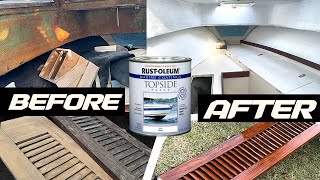 Boat cabin & teak door makeoverPerfect Fit Boating
 Cuddy cabin upholstery — Bayliner CapriFriendnFamily
 Full half-cabin boat restoration, start to finishLeth O's Adventures
 How to make V-berth cushionsSailrite
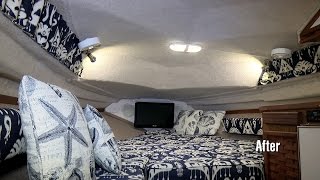 How to install carpet-style headlinerSailrite
 Replacing a soft cabin floorFriendnFamily
Aussie classic worth reading: Trade-a-Boat's 1974 Haines Hunter 213C project — a similar-era 21-footer; they turned the void between the V-berth bunks into an insulated icebox. Steal that idea.
Most refit forums (Ausfish etc.) block automated searches, so this is a starting list — post your own finds in the group chat and we'll add them.
🔨 Real Caribbean rebuilds
People have done this to boats just like ours. What it really costs to go all the way:
- The Captain — "Old school Caribbean rebuild": two brothers in WA, a Caribbean Invader 520, 3 years. The stringers turned out to be completely rotten. ~$35k all-in with a Suzuki DF140, 38 knots.
- Trade-a-Boat project boat — 1976 Caribbean Invader: transom repair + four-stroke repower, $32,450 with a full cost breakdown. Required reading before we start.
- Ausfish — restored cruisers thread: before-and-after photos of Aussie half-cabins.
- Bertram 20 rebuild: same builder, same construction — good on transoms and stringers.
The lesson: those big numbers are structural repairs plus a new motor. If our transom is sound and the V6 runs, the cabin refresh below costs a few hundred to a couple of thousand dollars.
📐 A cabin plan for our Commodore
Lock-up cabin, V-berth for two, toilet, little stove, hardtop with sliding windows. Do it in phases, out of the kitty:
- Strip & assess (a Saturday, ~$50): everything out — cushions, carpet, junk. Hose-test the hardtop and windows for leaks. Check the bunk bases and the floor for soft spots. Photograph everything.
- Clean & seal (~$150–300): mould wash, new window and hardtop seals, a cut-and-polish of the gelcoat.
- Lining (~$100–300 DIY): paint the fibreglass cabin sides white or grey, or glue thin ribbed marine carpet over ply panels.
- Cushions (~$250–650 DIY / $500–1,500 trimmer): new high-density foam with a waterproof liner, covered in navy marine vinyl with coral piping (the CoPCO colours). Make a filler cushion so the V-berth becomes a full bed.
- Toilet: keep it if it's a Porta Potti (empty it at home), or replace it with a Thetford 335 (~$200). No overboard discharge anywhere in Victoria.
- Galley box (~$150): a removable ply box for the stove, kettle and a small basin. Lift it out on fishing days.
- Lights & power (~$100–200): warm-white LED strips, a 12V/USB panel, a cup holder or four.
- The fridge (~$700–1,500): a 40–50L compressor fridge under the passenger seat, plus a second battery with a DC-DC charger.
- Finishing touches: CoPCO burgee on the bow rail, the new name on the hull, a framed photo of Uncle Uncle in the cabin.
🗳️ Upgrade wishlist
Vote with a ⭐ — top-voted gets bought first.
Boat calendar
🌤️ Next few days off Carrum
📅 Plan a trip
Past plans
Upkeep & renewals
Add an item
Trips & catches
🏆 Leaderboard
Log a trip
Votes, names & merch
Voting as
1 · The official logo
2 · Which logo on which kit?
Tap a mockup to vote for it. Tap the colour dots to try other colours.
3 · Name the boat
Back as many names as you like — tap again to take your vote back. Add your own.
Scoreboard
4 · Merch order
Once the vote settles: put in your sizes and how many of each. Everyone sees the running order and the cost per head.
Prices & where to get it made
| Item | Ballpark each | Notes |
|---|
Small runs (5–10 of each) are fine for embroidery and DTF printing (usually a 10-piece minimum, no screens). Embroidery has a one-off digitising fee (~$50–80 per logo). Screen printing only pays at 25+. Stubby holders and golf balls have 50–100 minimums. Prices mostly ex-GST — add 10%. Close to Heathmont: Fully Promoted Mt Waverley; also Melbourne Merch (DTF and embroidery from 10 pieces). Jacket: Gill OS3 Coastal ~$350 — buy the jackets, then have them embroidered. The crest and retro patch embroider cleanest; the full badge prints best.
Print files
High-res (3000px) logo files for the printer:
For embroidery (caps, polos) the printer will usually "digitise" the logo — simpler logos (the crest, the retro patch) embroider cleanest. The full badge works best printed (tees, stubby holders, towels).